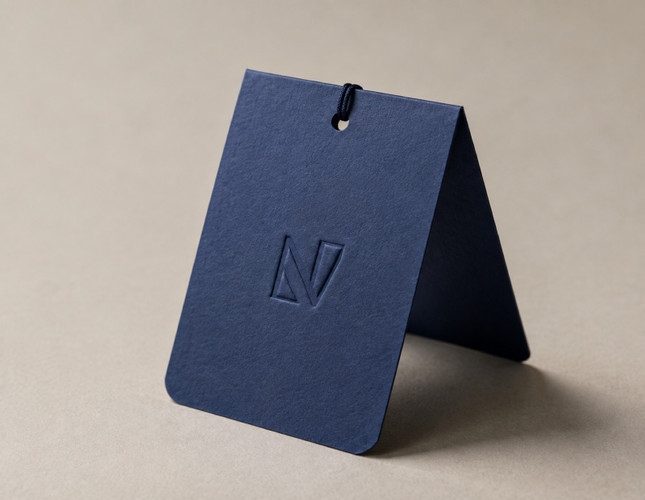


Description
Die Cut Hang Tags
Every other tag on the rail is a rectangle. That is the entire argument for die cutting. Before anyone reads a word of your tag, its outline has already told them your brand thought about something the competition did not.
At printshaQ we cut hang tags to custom shapes using the same process behind our die cut business cards — a page that outranks printers many times our size, because shape is the one thing a photograph cannot fake. Die cutting is pre-selected here, so the price covers a shaped tag rather than a square one you have to upgrade.
What Are Die Cut Hang Tags?
Die cut hang tags are product tags cut to an outline other than a rectangle. That might be a gentle change — rounded ends, an angled corner, a notch — or a full silhouette matching your logo, your product or the thing the tag hangs on.
Elsewhere you will hear these called swing tags, swing tickets, shaped tags, custom shape tags or contour cut tags. Retail buyers sometimes ask for a “profile cut”. It all describes the same job: a blade or a beam following a line you drew instead of the four the machine assumes.
Why Die Cut Hang Tags Work
- Shape registers before content. The brain processes silhouette faster than text or color, so an unusual outline is working before anyone has focused on the tag.
- It cannot be copied cheaply. A competitor can match your paper and your ink from any supplier. Matching a custom die means committing to it.
- It survives being small. A distinctive outline still reads at thumbnail size in a product photograph, where fine print does not.
- It can serve a function. A notch that grips a bottle neck, a slot that slides over a handle, a fold that stands on a shelf — shape can do a job, not just look like one.
Standard Die Cut vs Laser Die Cut
Two ways to cut a shape, and the right one depends on the outline.
Standard die cutting uses a steel rule die pressed through the board. It is fast, economical and ideal for common shapes — rounded ends, arches, tags with a corner removed, simple silhouettes. The cost stays low and the cut edge is clean and slightly burnished.
Laser die cutting burns the outline with a beam, so no physical die is made at all. That removes tooling costs entirely and makes genuinely intricate work possible: interior cutouts, filigree, lettering cut clean through the board, curves too tight for a steel rule to hold. It costs more per piece and leaves a very slightly darkened edge, which on most stocks reads as a deliberate detail.
Unsure which your artwork needs? Send it over and we will tell you honestly — there is no advantage to us in selling you laser for a shape a standard die handles.
Who Uses Die Cut Hang Tags
- Bakeries and food producers. A tag cut to the shape of a loaf, a bean or a leaf, tied to the bag it describes.
- Plant shops and garden centres. Leaf-shaped tags and stake-shaped tags that push into soil.
- Pet brands. Bone, paw and collar-tag silhouettes, which customers keep long after the purchase.
- Toys and childrenswear. Shape does more than copy ever will in a category where the buyer and the user are different people.
- Breweries and distilleries. Neck tags cut with a slot to sit over the bottle without string.
- Homeware and furniture. A tag cut to echo the product silhouette, tied to the leg or handle.
Die Cut vs Standard Rectangular Hang Tags
A rectangular hang tag is efficient in every respect — cheaper to produce, faster to turn around, easier to design for, and it stacks and ships without fuss. For large runs where price per unit rules, it is the correct choice, and our standard hang tag printing does exactly that job well.
A die cut tag trades some of that efficiency for recognition. On a rail of forty products where thirty-nine tags are the same rectangle, the fortieth gets picked up. That is worth more on a considered purchase than on a three-dollar impulse buy — so match the finish to the product, not to the budget.
Premium Upgrades on the Same Tag
The die cut is already selected. Shape combines well with everything else we run:
- Foil stamping — metal following the edge of a custom silhouette. See foil stamped hang tags.
- Embossing or debossing — relief inside a shaped outline, texture and form together. See embossed hang tags.
- Spot UV — gloss tracing the cut edge to emphasise the profile. See spot UV hang tags.
- Colored or foiled edges — on thick stock a painted edge follows the whole custom outline, which is striking on a curve.
Stocks for Shaped Tags
Thicker board holds a shape better. A slim projection on thin stock bends in transit; the same shape on 32pt arrives as drawn.
- 32pt and 48pt — strongly recommended for anything with a narrow neck, a projecting element or an interior cutout
- 16pt — fine for gentle shapes such as rounded ends or a clipped corner
- Silk matte and suede lamination — both cut cleanly and resist edge scuffing
- Uncoated cotton and uncoated smooth — a softer cut edge, well suited to organic and handmade shapes
- 22pt black suede — dark board where the cut edge stays dark rather than showing a white core
Sizes, Hole Punching and String
Shaped tags are quoted from a base size, and our standard is 2" x 3.5". Also available: 1.5" x 3.5", 1.75" x 3.5", 2" x 2", 2.5" x 2.5", 2" x 4", 2" x 6" and 3" x 3". Your die sits within the size you choose — if your shape needs a footprint outside these, contact us and we will quote it.
Holes are punched top center as standard, or top left and top right, in 4mm, 5mm or 6mm. On a custom shape, tell us where the hole belongs relative to the outline — the geometric top is often not where the tag hangs level.
String can be added to your order rather than sourced separately.
Artwork Setup for Die Cut Hang Tags
- Print-ready PDF, fonts outlined, 300 DPI, CMYK
- A separate die line as vector artwork — a single closed path showing exactly where the cut runs, on its own layer
- Extend background color at least 1/8" beyond the die line so no white shows on a slight shift
- Keep text and logos well inside the cut, and further in around tight curves
- Avoid projections narrower than about 1/4" unless you are on 32pt or heavier
- Zip the print file, the die line and any finish masks together before uploading
Have a logo but no die line? Choose the design option at checkout and we will draw one.
Not Sure Which Finish?
- Choose die cut hang tags when the outline itself should carry the brand.
- Choose foil stamped hang tags for metallic shine.
- Choose embossed hang tags for texture you can feel.
- Choose spot UV hang tags for gloss against matte.
Browse all specialty print finishes, or start at hang tags if you would rather choose stock before finish.
Order Die Cut Hang Tags
Choose stock, size, quantity and any additional finishes above — the price updates as you build, with no quote request in the way.
Anyone can print a rectangle. The shape is the part a customer notices from across a shop, and the part they still remember once the tag is in a drawer at home.