
What Is Spot UV?
27th Apr 2026
What Is Spot UV? The Complete Guide to Spot UV & Raised Spot UV Printing
Why Some Business Cards Just Feel More Expensive
You’ve held one before. A business card, a postcard, a box — something that looks completely ordinary until it catches the light, and suddenly there’s a logo or a design element glowing with a glossy shine against a flat, matte background. It’s subtle. It’s tactile. And it’s one of the most effective ways to make printed material feel expensive without redesigning a single thing.
That effect has a name: spot UV. And once you understand what it actually is, you’ll start noticing it everywhere — on business cards, product packaging, wedding invitations, book covers, and premium retail boxes.
This guide covers everything: what spot UV actually is, how it’s applied, the difference between flat and raised spot UV, how it compares to spot gloss, where it gets used, and the design tricks (like the “invisible until tilted” watermark effect) that make it one of the most versatile finishes in print.
What Is Spot UV?
Spot UV is a glossy, clear coating applied to specific areas of a printed piece — not the whole page — to create contrast between glossy and matte finishes. The name comes from the process: a UV-curable liquid coating is applied in a precise pattern (the “spot”), then cured almost instantly under ultraviolet light, which hardens it into a durable, glass-like finish.
The key word is spot. Unlike an all-over gloss coating (aqueous coating, laminate, or full UV coating) that covers the entire printed surface, spot UV is selectively applied only where you want it — a logo, a headline, a border, a single icon, or an entire background with a shape cut out of it.
Because it’s applied over a matte or uncoated base, the contrast is what sells it. Glossy sits on matte. Shine sits on flat. Your eye is drawn straight to it.
Flat Spot UV vs. Raised Spot UV — What’s the Difference?
This is one of the most common points of confusion, and it’s worth being precise about, because the two finishes look and feel completely different.
Flat spot UV is a thin, high-gloss coating that sits smooth against the surface. You can see it — the shine is obvious — but you generally can’t feel a raised edge when you run your finger over it. It’s a purely visual effect.
Raised spot UV (sometimes called 3D spot UV, or thick spot UV) uses multiple layers of UV coating to build actual physical height, so the coated area sits noticeably raised above the surface of the card. You can feel it — a tactile, almost rubbery bump you can run your finger across. This is the finish people mean when they specifically search for “raised spot UV business cards,” and it tends to read as more premium than flat spot UV because of that extra sensory layer.
If flat spot UV is “shiny,” raised spot UV is “shiny and dimensional.” Both use the same core UV-curing process — raised spot UV just applies more of it, in more passes, to build height.
Spot UV vs. Spot Gloss — Are They the Same Thing?
Mostly, yes — “spot gloss” and “spot UV” are used interchangeably in the industry, and both refer to the same selective glossy coating. Where it gets murky is when people use “spot gloss” to describe aqueous spot coating (a water-based version, less durable, less glossy, and UV-cured much slower or not at all) versus true spot UV (UV-cured, near-instant, glossier, and more scratch-resistant).
For most practical purposes — including anything you’re ordering from a print shop — “spot UV” and “spot gloss” describe the same visual effect: a glossy coating selectively applied over a matte base. If a printer specifically distinguishes between the two, it’s almost always about which coating technology and durability level they’re using, not a difference you’d notice by looking at the finished piece.
The Invisible Watermark Effect
Here’s the trick most people don’t know about until they see it: spot UV doesn’t require ink or color underneath it to work.
When you apply spot UV directly onto blank, uncoated card stock — no ink, no color, nothing — you get a subtle, tone-on-tone effect. Under straight-on lighting, it’s almost invisible; you might not even notice it’s there. Tilt the card under a light source, and the coated shape suddenly appears, glossy against the matte stock around it, like a hidden watermark revealing itself.
This is a favorite technique for:
- Subtle branding — a logo or wordmark that’s there for people who look closely, without dominating the design
- Security-style watermarks — mimicking the look of a banknote or certificate watermark for a premium, “this is authentic” feel
- Minimalist card design — an all-white or all-black card that reveals a hidden pattern or texture only under certain light
It’s one of the most understated, sophisticated uses of the finish — and one of the easiest to miss if you don’t know to look for it.
Layering Spot UV Over Color, Ink, and Logos
The flip side of the watermark effect is using spot UV directly over printed color or a logo — which is the far more common application. Here, spot UV isn’t hiding, it’s amplifying.
When you print full color (or even a single dark ink) and then apply spot UV precisely over the logo, headline, or design element, you get:
- Contrast-driven emphasis — the glossy area visually “pops” forward against the matte surrounding it, drawing the eye without needing brighter colors or larger type
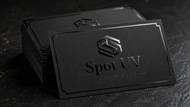
- A layered, dimensional look — especially effective over dark backgrounds (black, navy, deep maroon), where the shine reads almost like a subtle spotlight
- Logo reinforcement — spot UV traced exactly over a logo shape reinforces brand recognition every time the card catches light, even from across a room or table
This is the version most people picture when they hear “spot UV business cards” — a black card with a glossy logo, or a colorful design with a single UV-coated accent that makes the whole piece feel more considered.
Where Spot UV Gets Used
Spot UV isn’t limited to business cards — it shows up anywhere a print piece needs to stand out physically, not just visually. Real search demand (and real production runs) spans:
- Business cards — the single most common application; flat or raised spot UV over a logo, name, or border
- Postcards & direct mail — a glossy accent that makes a mailer more likely to get picked up rather than tossed
- Rack cards & hang tags — retail and hospitality use spot UV to make a small printed piece feel like a premium product, not a flyer
- Labels & stickers — spot UV on product labels (skincare, spirits, specialty food) signals quality before a customer even reads the packaging
- Packaging & product boxes — one of the biggest commercial uses; spot UV over a logo or pattern on retail packaging is a low-cost way to look high-end on a shelf
- Invitations — wedding and event invitations use spot UV (often combined with foil) for a formal, elevated feel
- Folders & presentation materials — spot UV over a logo on a presentation folder cover adds polish for pitch decks, proposals, and press kits
- Flyers — less common, but effective for a single high-impact accent on an otherwise flat piece
If you’re producing any of these and haven’t considered spot UV, it’s worth a look — browse our full spot UV business card options or explore raised spot UV business cards to see the raised effect in person.
How Spot UV Is Actually Applied (The Production Side)
For anyone curious about what happens on the production floor: spot UV is applied after the base printing is complete and (usually) after any laminate finish — silk matte or suede lamination is the most common base, since the contrast between a soft-touch matte laminate and a glossy UV coating is where the effect really shines.
A UV-curable coating is applied through a screen or digital coater in the exact shape specified by your design’s spot UV file (more on that below), then passed under a UV light source that cures it almost instantly — hardening it into a durable, scratch-resistant finish. Raised spot UV repeats this process in multiple passes to build up physical thickness before the final cure.
Because the coating is cured by light rather than air-dried, spot UV holds a crisp edge — which is why it works so well for fine detail like small logos, thin text, or intricate patterns that a thicker finish (like foil or embossing) might blur.
Setting Up a File for Spot UV
If you’re designing your own artwork, spot UV requires a separate file from your main design — usually referred to as a spot UV file, spot UV mask, or spot UV layer. This file is typically:
- The exact same dimensions as your print file
- Solid black (or a single spot color) only in the areas where you want the UV coating applied
- Completely white/transparent everywhere else
Whatever is black in that file is where the glossy coating goes — nothing more, nothing less. This is the same convention used for foil stamping and embossing masks, so if you’ve set up a file for either of those before, spot UV works the same way.
A few practical tips:
- Uncoated and matte stocks show the most contrast. Spot UV on a high-gloss stock barely registers, since there’s no matte-to-glossy contrast to see. Silk matte, suede laminate, and uncoated stocks are where spot UV looks its best.
- Fine detail holds up well, but very thin lines (under roughly 0.5pt) can be risky to reproduce cleanly — check with your printer if your design leans on delicate linework.
- Dark backgrounds tend to show spot UV more dramatically than light ones, since the reflective shine reads more clearly against deep color or black.
If you’re not sure how to build the mask file yourself, most print shops (printshaQ included) can help you set it up from a standard design file — you don’t need to be a production expert to use the finish.
Pairing Spot UV With Other Premium Finishes
Spot UV rarely works alone on the most premium print pieces — it’s frequently combined with other finishes for a layered effect:
- Foil stamping: Metallic foil for color and shine, spot UV for glossy contrast — together, one of the most eye-catching combinations available. See our foil stamped business cards
- Embossing / debossing: Raised or recessed texture without shine, paired with a glossy spot UV accent elsewhere on the same piece
- Die cutting: Custom shapes combined with a spot UV detail for a fully custom, multi-technique card
- Painted edges: Color on the edge of the card stock plus a spot UV logo on the face — a favorite combination for luxury and real estate branding
Spot UV vs. Other Premium Finishes — Which Should You Choose?
| Finish | What it does | Best for |
|---|---|---|
| Spot UV | Glossy shine over matte, selectively applied | Contrast, subtle branding, logo emphasis |
| Raised spot UV | Same as above, with physical texture/height | Tactile impact, premium feel |
| Foil stamping | Metallic color applied with heat and pressure | Bold color, luxury branding |
| Embossing/debossing | Raised or recessed texture, no color change | Texture without shine |
| Matte/silk lamination | Soft-touch, non-reflective base finish | The canvas spot UV is applied on top of |
Not sure which is right for your project? Our Embossing vs. Spot UV guide breaks down that specific comparison in more depth.
Frequently Asked Questions
What is spot UV printing?
Spot UV printing is a finishing technique that applies a glossy, UV-cured coating to specific areas of a printed piece, creating contrast between glossy and matte surfaces. It’s applied after base printing using a separate file that defines exactly where the coating goes.
What’s the difference between spot UV and raised spot UV?
Flat spot UV is a smooth, glossy coating you can see but not necessarily feel. Raised spot UV builds physical height through multiple coating passes, so the design element is both glossy and tactile — you can feel it raised above the surface.
Does spot UV work on uncoated paper?
Yes, and it often looks best there — the contrast between an uncoated, matte surface and the glossy UV coating is more dramatic than on an already-glossy stock.
Can spot UV be used as a watermark?
Yes. Applied directly onto blank card stock with no ink underneath, spot UV creates a subtle, tone-on-tone effect that’s nearly invisible under straight lighting and appears only when the piece is tilted — a popular technique for understated branding or a security-watermark aesthetic.
What’s the best background color for spot UV?
Darker colors (black, navy, deep maroon) tend to show off spot UV most dramatically, since the glossy shine reads as a clear highlight against the deep color. That said, spot UV works on any color — it’s really about how much contrast you want between the coated and uncoated areas.
Do I need a special file to order spot UV printing?
Yes — a separate file (often called a spot UV mask) showing only the areas that should be coated, usually in solid black against a white or transparent background. If you’re not sure how to build one, most print shops can help set it up from your existing design.
Is spot UV the same as spot gloss?
Functionally, yes — both terms describe a selectively applied glossy coating. Some printers use “spot gloss” to refer specifically to aqueous (water-based) coating versus UV-cured spot UV, but visually the two are nearly indistinguishable in the finished product.