
Business Card Thickness Explained: 12pt vs 14pt vs 16pt (GSM & lb Guide)
22nd Feb 2026
<!doctype html>
Paper Thickness Explained: Points (pt) vs GSM vs Pounds (lb)
If you’ve ever shopped for business cards, postcards, invitations, or packaging inserts, you’ve probably seen paper described in three different ways:
- Points (pt) like 12pt, 14pt, 16pt, 32pt, 48pt, 64pt
- GSM (grams per square meter) like 300gsm, 350gsm, 400gsm
- Pounds (lb) like 80lb, 100lb, 130lb
The problem is… these systems don’t translate perfectly. Two sheets can both be called “100 lb” and feel totally different. A 16pt card can feel stiffer than another 16pt card. And GSM tells you weight—not necessarily thickness.
So let’s break it down in plain English, the way we explain it to customers at printshaQ.com.
The simplest way to think about it
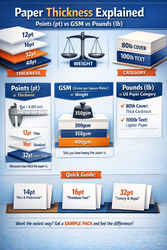
- Points (pt) = thickness (how thick the sheet is)
- GSM = weight (how heavy the sheet is)
- Pounds (lb) = weight, but with a catch (depends on the paper category)
If your goal is “I want this to feel premium,” points (pt) is usually the easiest and most honest measurement.
And if you want to feel the difference in real life, the fastest shortcut is a free sample pack—because paper choice is one of those things that makes sense instantly once you hold it.
What does “pt” mean?
Point (pt) is a thickness measurement. In printing, it usually refers to caliper (sheet thickness).
- 1 pt = 0.001 inch (one “thousandth” of an inch)
So:
- 12pt = 0.012"
- 16pt = 0.016"
- 32pt = 0.032"
- 64pt = 0.064"
That’s why point numbers are so useful for things like business cards and premium invitations. It’s literally thickness.
Quick “feel” guide for common pt stocks
- 12pt: thinner card; decent, but not “luxury”
- 14pt: standard “nice” card; common baseline
- 16pt: thicker, more premium-feeling business card
- 32pt: “statement” thickness (often built by bonding sheets)
- 48pt: ultra-thick specialty stock (starts feeling rigid)
- 64pt: extremely thick; used for high-end, rigid pieces
Note: coatings and laminations can increase stiffness and sometimes slightly change thickness, so “feel” can vary even at the same pt.
GSM: helpful, but not the whole story
GSM = grams per square meter. It’s a global standard and it’s consistent across paper types. But GSM measures weight, not thickness.
Two papers can be the same GSM and feel different because:
- paper density changes (cotton vs coated)
- coatings add stiffness
- the paper “bulks” differently (some papers are thicker at the same weight)
Still, GSM is great when you’re choosing between common ranges, especially for postcards and invitations.
Rough GSM ranges (useful in real life)
- 200–250gsm: sturdy flyer / light card
- 300gsm: common “card stock” range (postcards, invites)
- 350gsm: premium-feeling cover stock
- 400gsm+: very heavy cover; starts feeling “extra”
Pounds (lb): the most confusing system
In the US, paper is often measured in basis weight (lb), like “100 lb cover” or “80 lb text.” Here’s the catch:
The “lb” number depends on the paper category (text, cover, bond, index, etc.). So 100 lb text is not the same thing as 100 lb cover.
That’s why someone orders “100 lb” expecting a thick postcard and ends up with something that feels like a brochure.
The key rule
Always ask (or specify) whether the pound weight is:
- Text (lighter, used for letterheads and pages)
- Cover (heavier, used for cards and covers)
Comparing pt to GSM (and lb): practical equivalents
There is no perfect universal conversion, but for typical coated cover stocks (common for business cards), these approximations are helpful.
Points (pt) to approximate GSM (common coated cover)
- 12pt ≈ 260–275gsm
- 14pt ≈ 300–310gsm
- 16pt ≈ 350gsm
- 32pt ≈ 700gsm (duplex build — two 16pt sheets bonded together)
- 48pt ≈ 1,050gsm (triplex build — three 16pt sheets bonded together)
- 64pt ≈ 1,400gsm (quad build — four 16pt sheets bonded together)
Why the wide ranges? “Bulky” uncoated papers can be thicker at the same GSM, and laminations / bonding change the math.
Points (pt) to rough “cover weight” (US cover)
- 12pt ≈ ~100 lb cover
- 14pt ≈ ~110–120 lb cover
- 16pt ≈ ~130 lb cover
- 32pt ≈ ~260 lb cover equivalent (if it’s a duplex build)
If you remember only one thing: 16pt is roughly in the “130 lb cover / ~350gsm” neighborhood in the premium business card world.
If you’re shopping specifically for higher-end cards, this is exactly why people gravitate toward premium business cards—the thickness, stiffness, and finish just read “higher quality” immediately.
Why two “16pt” cards can feel different
A few reasons:
1) Coating and lamination
- Soft-touch lamination can make a card feel smoother and more luxurious.
- Matte and gloss coatings change how “hard” the card feels.
- Some laminations slightly increase thickness but noticeably change stiffness.
2) Paper type and density
Cotton papers are often bulkier and softer. Dense coated papers can feel sharper and snappier.
3) Grain direction
Paper has grain. Depending on how it’s cut, the sheet can feel more or less stiff.
4) Build method (especially on 32pt+)
A “32pt” stock is often created by bonding sheets together. Construction affects stiffness a lot.
And if you want a finish that immediately signals “premium,” this is where things like foil come in—especially when paired with a thicker stock. Example: foil stamped business cards tend to look and feel more expensive because the finish adds contrast and detail people notice up close.
Which thickness should you choose?
Here’s a clean decision guide.
Business cards
- 14pt: solid standard, good for everyday use
- 16pt: premium feel without going “novelty thick”
- 32pt: statement piece, luxury vibe, “wow” factor
- 48pt/64pt: ultra-luxury, specialty use (VIP, high-end brands, rigid pieces)
If you’re searching locally and want help choosing the right direction fast, this guide pairs well with our business card printing near me page—especially if your priority is quick turnaround plus higher-end options.
Postcards
- 12pt–14pt is common
- 16pt feels premium and is great for high-end direct mail
Invitations
- 300–350gsm (or ~14pt equivalent) is a classic “nice invitation”
- 16pt / 400gsm steps it up (especially with minimal design)
- 32pt+ is luxury territory, especially with premium finishes
Packaging inserts and thank-you cards
- 14pt–16pt hits the sweet spot of premium + practical
The best way to shop paper (without getting burned)
- Decide whether thickness or weight matters more
- For “luxury feel” → think pt
- For “mailing cost / heft” → think gsm
- If using lb, always specify the category
- “100 lb cover” is not “100 lb text”
- Get samples
Paper is one of those decisions that’s nearly impossible to judge from a screen. If you want the quickest shortcut, grab a free sample pack and compare the difference between standard and premium stocks side-by-side.
Final takeaway
- Points (pt) = thickness and the cleanest way to compare premium card stocks
- GSM = consistent weight measurement, great for global comparison
- Pounds (lb) = useful in the US only when you know whether it’s text or cover
If you’re building a brand that wants to look high-end, paper thickness isn’t a tiny detail—it’s part of the message. The right stock makes a design feel more confident, more intentional, and more premium before anyone reads a word.